Study in the USA from Bangladesh 2026: Costs, F-1 Visa, Jobs and No-IELTS Options
US costs and intakes, admission steps, the F-1 visa roadmap, on-campus work, CPT/OPT and universities without IELTS.
Global Vision
Country guidesPublished 11 Oct 2026Updated 28 Oct 20268 min read
Quick answer
To study in the USA from Bangladesh you need a university admission and Form I-20, then an F-1 visa interview at the U.S. Embassy in Dhaka. Budget $25,000–45,000 a year and show funds for at least the first year. F-1 students can work up to 20 hours a week on campus, and OPT gives 12 months of work after graduation (36 months for STEM). Fall is the main intake, with applications open from November to March, and many universities accept alternatives to IELTS.
The USA offers flexible degrees, strong research funding and a direct line from campus to some of the world’s biggest employers. Here is the practical picture for 2026–27 applicants.
$25–45ktypical total cost per year
6–12 moapply this far ahead of your start date
20 hrsmax weekly work during classes
12 + 24months of OPT, with STEM extension
Check before you rely on any figure. Fees, visa procedures and work rules were checked against Travel.State.Gov, Study in the States and USCIS guidance in late October 2026, and they change often. Confirm with your university and the U.S. Embassy in Dhaka before you apply.
What changed for 2026. Student visa applicants must set their social media profiles to public and list usernames from the last five years on the DS-160 (since June 2025). Bangladeshi students should interview at the U.S. Embassy in Dhaka. A $250 visa integrity fee was created by law in July 2025, but collection is uneven, so check before you pay. The $15,000 visa bond announced for Bangladesh in January 2026 applies to B1/B2 visitor visas, not to student visas.
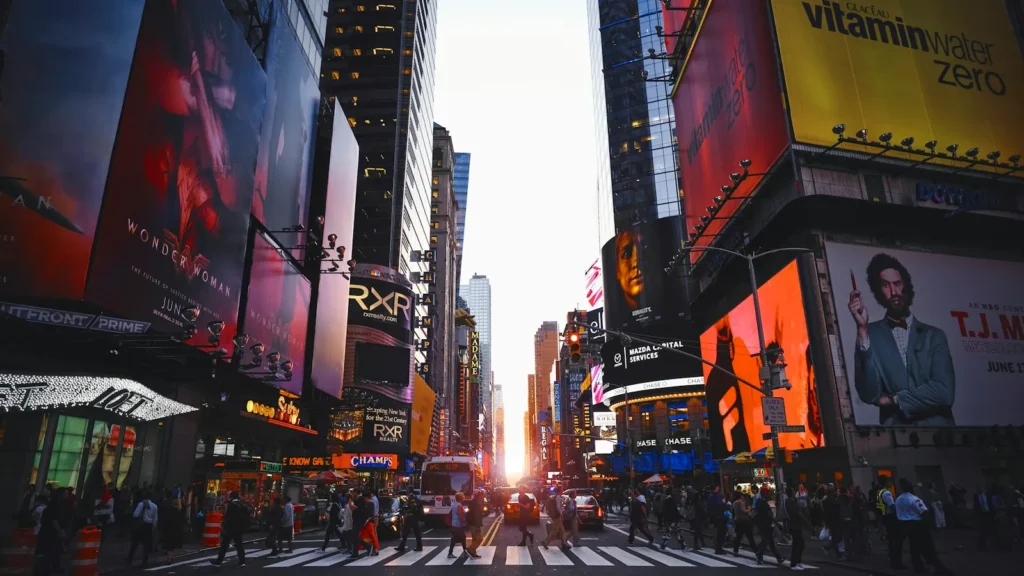
Photo: Unsplash. Big-city campuses offer more jobs but cost more to live in.
Intakes and deadlines
Most universities run three intakes. Fall is the biggest, with the most scholarships and programmes open.
Starts: August / September Apply: November – March
Best choice for most students: widest programme selection and funding.
Starts: January / February Apply: July – November
Good if you missed Fall or finish your degree in December.
Starts: May / June Apply: August – February
Limited programmes; often used for short or accelerated courses.
Degree levels and duration
Programme
Duration
Typical yearly cost (USD)
In BDT (approx.)
Associate degree
2 years
$10,000–20,000
৳12.4–24.8 lakh
Bachelor’s
4 years
$12,000–40,000
৳14.9–49.6 lakh
Master’s / MBA
1–2 years
$10,000–40,000
৳12.4–49.6 lakh
Doctorate / PhD
4–7 years
University-specific
Often funded
Taka figures use about ৳124 per US$1 (Bangladesh Bank rate, late October 2026).
Popular fields: engineering, computer science, health sciences, psychology, business management, life sciences, finance and economics.
About work after study: different pages quote different numbers. The reliable rule is that OPT gives 12 months of work authorisation after graduation and eligible STEM graduates can extend by 24 months (36 in total). See the work-rules guide linked at the end.
Costs, budget and funds you must show
Average yearly tuition for popular master’s degrees
Master’s degree
Avg yearly tuition
MBA
$53,000
Law (JD)
$51,000
Data Science
$35,000
Computer Science
$31,000
Electrical Engineering
$30,000
Civil Engineering
$27,000
Indicative averages. Every university sets its own fee, so check the course page.
Monthly living costs
Plan on $600–1,350 a month. On-campus housing is usually cheaper than renting off campus, New York is the priciest and Texas is cheaper.
Item
Per month (USD)
Accommodation
$400–900
Groceries
$150–350
Utilities
$50–100
Total
$600–1,350
Cheaper student cities include Lubbock and Cincinnati. More affordable options include the CUNY and California State University systems, the University of South Florida and the University of Georgia. Berea College gives every admitted student a tuition scholarship, but admission is very competitive.
First-year funds calculator
Three choices. The amount your university writes on the I-20 is the one that counts; use this to plan.
Scholarship on tuition
Tuition after scholarship
Living (12 months)
Funds to show for year one
In taka
Includes about $1,500 for travel and set-up costs. Converted at ৳124 per US$1. Campus work (up to 20 hours a week at $10–15 an hour, roughly $6,000–9,000 a year) can help with living costs, but it does not count as visa funds.
Funds you must show for the visa
Embassies want to see that you can pay for tuition, living and travel. Showing funds for at least the first year is the recommended minimum.
Overall, total yearly cost for study and living commonly lands between $25,000 and $45,000. Monthly living: accommodation $400–900, groceries $150–350 and utilities $50–100.
Admission requirements
Academic transcripts
SAT or ACT score, if the university asks for it
English proficiency (TOEFL, IELTS, PTE, iTEP or Duolingo)
Essay or personal statement
Letters of recommendation
Valid passport
Proof of finances
Academic transcripts
GRE or GMAT, depending on the programme
English proficiency (TOEFL, IELTS, PTE, iTEP or Duolingo)
Statement of purpose (and a research proposal if required)
Letters of recommendation
Valid passport
Proof of finances
Your university must also be SEVP-certified to issue an I-20.
English tests: TOEFL, IELTS, PTE Academic, iTEP and (at many schools) Duolingo. Some universities waive the test if your previous education was in English. Studying without IELTS is possible — see our visa, part-time work and no-IELTS guide for a shortlist approach.
F-1 student visa: types and step-by-step roadmap
Which student visa do you need?
The standard visa for full-time academic study at a university, college or language programme. This is the one most Bangladeshi students apply for.
Needs Form I-20 from a SEVP-approved school
Allows on-campus work, and CPT/OPT with approval
For exchange visitors, including many research, scholar and fellowship programmes.
Needs Form DS-2019 from a sponsor
Common for fellowships and exchange schemes
For vocational or technical (non-academic) training.
Usually a shorter course
More limited work options than F-1
Your school must be approved by the Student and Exchange Visitor Program (SEVP) before it can issue the documents you need.
Your F-1 visa roadmap
Tap each step to mark it complete.
Accept your offer and receive Form I-20The university issues the I-20 after admission and proof of funds.
Complete the DS-160The online nonimmigrant visa application form.
Pay the feesThe SEVIS I-901 fee ($350) and the visa application fee ($185). Keep both receipts.
Upload a recent photographFollow the official photo specifications.
Book and attend your interviewHeld at the U.S. Embassy in Dhaka.
Receive your decisionMost decisions are given at the interview. Some cases need extra administrative processing, which can take weeks, so do not book flights early.
0 of 6 steps done
Documents to bring
Working in the USA: on-campus, CPT and OPT
Working rules are the part students misunderstand most. Tap each option to see what is allowed and when.
Up to 20 hours a week while classes are in session and full-time during official breaks (some sources note up to 40 hours in vacations depending on your status).
Typical jobs: library assistant, food service, barista, data entry, sales associate. Pay is usually $10–15 an hour.
Curricular Practical Training covers internships directly related to your major, generally available after your first academic year.
Your DSO (Designated School Official) must authorise it.
Optional Practical Training gives 12 months of work authorisation related to your major after graduation. You apply through USCIS with your DSO’s recommendation.
OPT continues in 2026. DHS has signalled new practical-training rules and possible OPT fees, so check Study in the States before you apply.
Eligible STEM graduates can add a 24-month extension, for a total of 36 months. Later options include H-1B work visas and permanent residency.
On-campus pay rarely covers tuition. Treat it as help with living costs, not your main funding.
Studying without IELTS
“Without IELTS” does not mean without English proof. Most U.S. universities accept TOEFL, Duolingo, PTE Academic or iTEP in place of IELTS, and some waive the test if your previous degree was taught fully in English. Highly selective universities usually still require a test score, so check the exact policy on each programme page.
Always confirm per programme. A university may accept alternatives for some courses but not others. Ask the admissions office to confirm in writing before you rely on a waiver.
Scholarships and funding
🎓
Fulbright
Prestigious fully funded awards for graduate study and research.
🤝
Hubert Humphrey Fellowship
Professional-development programme for mid-career leaders.
🏫
University scholarships
Merit-based grants for international students, often decided at admission.
🔬
Assistantships
Teaching and research assistantships for graduate students, especially PhD.
Students with a CGPA above 3.5 are more likely to win undergraduate scholarships. Fully funded awards need a strong profile plus a good research proposal. Apply early and read each eligibility rule.
Best cities for Bangladeshi students
Each city suits a different goal. The tag shows what it is best known for.
Austin
Vibrant tech scene.
Tech careers
Boston
Academic excellence and rich history.
Culture
Los Angeles
Creative hub, very diverse.
Culture
Chicago
Cultural richness and a strong job market.
Culture
New York City
Global opportunities and the largest Bangladeshi student community, but high cost.
Tech careers
Philadelphia
Historic, more affordable, top universities.
Budget-friendly
San Francisco
Innovation hub for tech careers.
Tech careers
Seattle
Tech-forward with access to nature.
Tech careers
Lubbock
Among the cheapest student cities.
Budget-friendly
Cincinnati
Among the cheapest student cities.
Budget-friendly
Photo: Unsplash. San Francisco and Seattle lead for tech.
Universities to explore
University
Type
MIT
Prestigious
Stanford University
Prestigious
Caltech
Prestigious
Harvard University
Prestigious
Yale University
Prestigious
Princeton University
Prestigious
NYU
Prestigious
USC
Prestigious
Northeastern University
Prestigious
Illinois Institute of Technology
Prestigious
CUNY
More affordable
California State University System
More affordable
University of South Florida
More affordable
University of Georgia
More affordable
Berea College
Tuition scholarship for all admitted students
Common mistakes to avoid
📅
Applying too late
Start 2–3 months before classes. Appointment slots can be limited.
📦
Thin financial proof
Show funds for at least the first year, clearly linked to your sponsor.
📝
Inconsistent forms
Names, dates and course details must match across the I-20 and DS-160.
💼
Assuming you can work anywhere
Off-campus work needs CPT or OPT approval from your DSO.
Want a second pair of eyes on your I-20 and bank documents?
Our counsellors check your file and run a mock visa interview, free of charge.
Apply and get admitted, take the required tests, receive an I-20, then apply for an F-1 visa and attend the interview at the U.S. Embassy in Dhaka.
How much does it cost to study in the USA?
Tuition ranges from about $10,000 to $50,000 a year depending on level and school, and living costs add roughly $7,000–16,000 a year. Total spend is commonly $25,000–45,000 a year.
Do I need IELTS to study in the USA?
Not always. Most universities accept IELTS, TOEFL, PTE, iTEP or Duolingo, and many accept another test score or a medium-of-instruction letter if you studied in English. Policies differ by programme, so confirm with each university.
Where is the F-1 visa interview held?
At the U.S. Embassy in Dhaka after you complete the DS-160 and book your slot.
How long does visa processing take?
Most decisions are given at the interview, and your passport usually comes back within a couple of weeks. Some applicants need extra administrative processing that can take longer. Apply to universities 6–12 months ahead and book your visa interview as soon as you have your I-20.
How many hours can I work on an F-1 visa?
Up to 20 hours a week on campus during classes and full-time during official breaks. Off-campus work needs CPT or OPT approval from your DSO.
What is the difference between CPT and OPT?
CPT is internship-style work during your studies tied to your curriculum. OPT is work authorisation related to your major, mostly after graduation.
Can I stay in the USA after graduation?
OPT gives 12 months, with a 24-month STEM extension for eligible graduates. H-1B and permanent residency are later routes.
Talk it through with a counsellor.
Free, one to one, in our Baridhara office or by phone.

 Global Vision